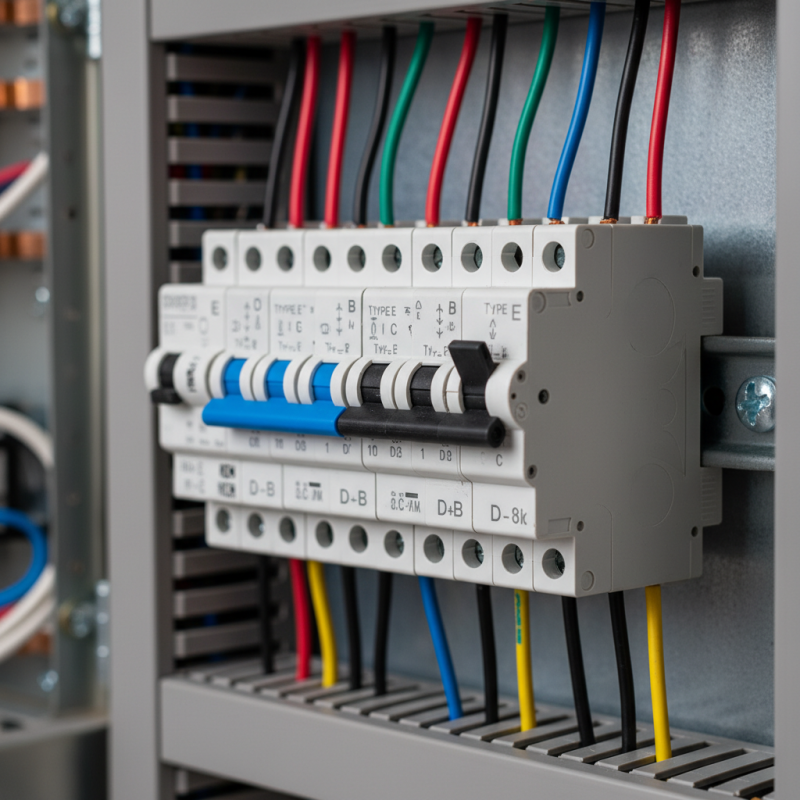
How to Choose a Miniature Circuit Breaker for Your Needs?
Choosing the right Miniature Circuit Breaker (MCB) can be crucial for your electrical needs. An MCB protects circuits by automatically turning off when overloaded or short-circuited. Selecting the best one involves more than just price.
You must consider the current rating, type of MCB, and application. Different types cater to various issues. For instance, a Type B MCB is ideal for general circuits, while a Type C suits motors. This variety can be confusing.
Inadequate knowledge might lead to poor decisions. It's essential to reflect on your specific requirements before making a purchase. The right MCB enhances safety and efficiency, but the wrong choice can be detrimental. Always research and consult experts when in doubt.
Understanding the Functionality of Miniature Circuit Breakers
Miniature circuit breakers (MCBs) play a crucial role in electrical systems. They protect circuits by interrupting the flow of electricity during faults. Understanding how these devices operate is vital for selecting the right one for your needs. MCBs detect overloads and short circuits, ensuring safety and compliance with electrical standards. According to industry reports, the global MCB market is projected to grow significantly, driven by rising electricity demand and safety regulations.
When choosing an MCB, consider the breaking capacity. This is the maximum fault current it can handle without failing. Most MCBs are rated between 6A and 63A. Be aware that having a breaker with too high of a rating may not protect your wiring effectively.
**Tips:** Look for MCBs with dual functions. They can protect against both overloads and short circuits.
Another factor is the type of MCB. They are categorized into types B, C, and D based on their trip characteristics. Type B is typically used for residential circuits, while Type C is common for commercial applications. If you have motors or inductive loads, consider Type D, as it can handle high inrush currents better.
**Tips:** Always verify the voltage rating. Using an MCB with the wrong voltage can result in malfunction.
Miniature Circuit Breaker Ratings and Their Applications
Identifying Your Electrical Load Requirements
Identifying your electrical load requirements is crucial when selecting a miniature circuit breaker (MCB). Different electrical systems have varying load demands. According to the International Electrotechnical Commission, proper load identification ensures safety and efficiency. A mismatch can lead to circuit overloads or equipment failure.
When assessing your load, consider the total wattage of all connected devices. For residential settings, small appliances like refrigerators and microwaves draw significant power. A typical refrigerator uses around 200-800 watts. Meanwhile, the combined load from electronics can reach 1,500 watts or more. It’s essential to add some buffer to account for future needs. The National Electrical Manufacturers Association suggests adding an extra 20% to your total calculated load to maintain operational safety.
Overestimating or underestimating load can cause problems. An undervalued load could lead to nuisance tripping. On the other hand, an overestimated load may give a false sense of security. Regular audits of your electrical systems help ensure ongoing safety. Engage a professional to evaluate load changes. This approach will provide insights and prevent costly mistakes, ensuring that your MCB choice effectively manages your electrical demands.
How to Choose a Miniature Circuit Breaker for Your Needs? - Identifying Your Electrical Load Requirements
| Load Type | Typical Load (kW) | Breaker Rating (A) | Number of Poles | Application |
| Lighting | 1 - 3 | 10 - 16 | 1 | Residential/Commercial |
| Small Appliances | 0.5 - 2 | 6 - 10 | 1 | Residential |
| Electric Ovens | 3 - 6 | 16 - 32 | 2 | Residential |
| HVAC Systems | 3 - 5 | 16 - 40 | 2 | Commercial/Industrial |
| Power Tools | 1 - 5 | 10 - 25 | 1 | Residential/Commercial |
Selecting the Right Current Rating for Your MCB
Choosing the right current rating for your miniature circuit breaker (MCB) is crucial. It directly affects your electrical system's safety and efficiency. An MCB protects against overloads and short circuits. But how do you determine the correct rating?
Start by assessing your electrical load. Calculate the total current required by your appliances. Don't forget to include peak usage. This will give you a baseline for the current rating you need. For residential use, typical circuits may require ratings of 6A, 10A, or 16A. It’s important to select an MCB that matches your needs without underestimating potential demands.
It can be tempting to choose a higher rating for flexibility. However, this could compromise safety. If the rating is too high, it won’t trip during an overload. Users often overlook this aspect, leading to potential hazards. Take time to evaluate your requirements carefully. You may need to adjust your calculations based on your lifestyle or future expansions. Always double-check your figures. A small error can lead to significant issues down the line.
Evaluating Trip Characteristics for Specific Applications
When selecting a miniature circuit breaker (MCB), it's essential to evaluate the trip characteristics that match your specific needs. MCBs protect electrical circuits by interrupting power flow during overloads or short circuits. They come in various trip settings, which can be confusing. Understanding these settings helps ensure proper functioning and safety.
Consider the application before choosing a trip characteristic. For example, a Type B MCB is ideal for residential use, handling small overloads. On the other hand, Type C and D MCBs are suitable for industrial settings, where devices like motors require a higher starting current. Reflect on what you need. Businesses often overlook this detail, leading to problems. Choosing an unsuitable trip characteristic can result in frequent tripping or failure to protect.
Moreover, take into account the environment. High humidity, dust, or temperature can affect an MCB's performance. Assess your space. Some users assume all MCBs are the same, which isn’t true. Each application has unique demands. Analyze your current setup and future expansion plans. Inadequately rated MCBs could escalate issues over time.
Considering Environmental Factors in MCB Selection
When choosing a miniature circuit breaker (MCB), environmental factors play a pivotal role. The location of installation is critical. For instance, outdoor installations face different challenges than indoor ones. Humidity, dust, and temperature variations can affect MCB performance. Choosing an MCB rated for specific environmental conditions is essential. This ensures that the breaker functions optimally without unnecessary failures.
Considering the ambient temperature is also vital. Many MCBs are rated for standard room temperatures. However, in extreme conditions, adjustments may be necessary. Too high or too low temperatures can lead to incorrect tripping or even overheating. Additionally, corrosive environments can damage MCB components over time. Regular maintenance might be overlooked, leading to long-term issues. It's worth noting that not all MCBs have the same level of protection against such elements.
Another often ignored aspect is the installation space. Adequate room for airflow is necessary. If an MCB is crowded, it may not dissipate heat effectively. This can increase the risk of failure. Users often underestimate these requirements, leading to reactive rather than proactive solutions. Reflecting on these details can save time and money in the long run. Always consider how your environment affects MCB selection to ensure reliability.