Choosing the right Abc Cable for global sourcing requires more than comparing prices on a supplier spreadsheet. The cable must match the project’s voltage, conductor material, insulation type, temperature range, and installation environment. A product designed for dry inland areas may perform differently near saltwater, heavy rain, or industrial pollution. Confirm these conditions before requesting quotations.
Experienced buyers usually begin with a clear technical specification. Include conductor size, insulation thickness, service voltage, expected load, drum length, and packaging requirements. Ask suppliers for test reports, certificates, factory quality procedures, and traceable batch records. Independent laboratory verification can provide extra confidence, especially when samples look identical but contain different materials. A practical inspection should check markings, insulation surfaces, conductor dimensions, drum protection, and moisture damage.
Supplier capability matters as much as cable design. Review production equipment, export history, lead times, and responses to technical questions. Request a pre-shipment inspection when the order is important. It may reveal small issues before a full container leaves the factory. However, no checklist is perfect. Documents can be outdated, and a successful sample may not represent every production batch. Keep communication specific, record approved specifications, and reassess the supplier after delivery. The best sourcing decision balances engineering evidence, field conditions, total cost, and dependable after-sales support. Cheap cable is not cheap when replacement requires weeks of shipping.
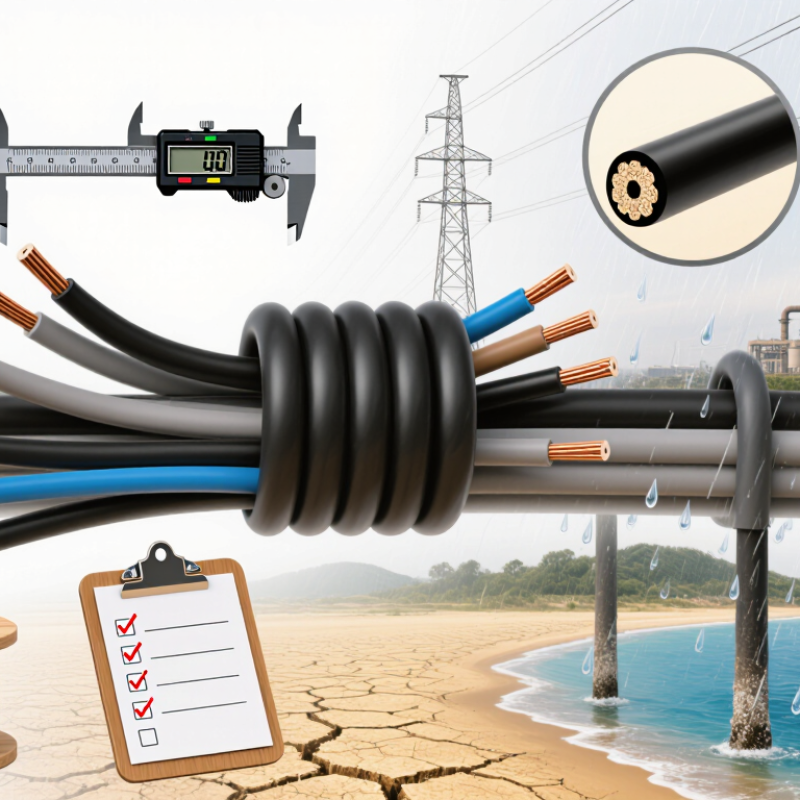
Aerial bundled conductor (ABC) cable groups insulated conductors into a compact overhead assembly. Depending on its design, it may include a supporting messenger and separate neutral conductor. Utilities use ABC on distribution networks, including streets with limited clearance or frequent tree contact. It can reduce some accidental contacts, but it does not remove the need for sound pole design, protection, and maintenance. Details matter.
The need for reliable distribution is substantial. The IEA’s Electricity 2024 report projects global electricity demand growth averaging 3.4% annually through 2026. Meanwhile, Tracking SDG 7: The Energy Progress Report 2024 estimates 685 million people lacked electricity in 2022. These figures point to continuing pressure on networks, though ABC cable is only one possible infrastructure choice. Not always.
For global sourcing, compare the actual installation conditions, not just the cable price. Check rated voltage, conductor material, current capacity, span length, expected sag, ambient temperature, and resistance to ultraviolet exposure. Verify short-circuit ratings, test documentation, applicable standards, and compatibility between cable and fittings. A neat specification sheet can miss a windy roadside or a hot service corridor. That deserves a second look. Local engineering review helps confirm whether the selected configuration suits the network and its maintenance practices.
| Selection Dimension | Typical Options or Data | Role in Power Distribution | What to Verify When Sourcing |
|---|---|---|---|
| ABC cable definition | Aerial Bundled Cable (ABC) is an overhead distribution arrangement in which insulated phase conductors are bundled together, usually by twisting them around a supporting conductor or messenger. | Provides an overhead alternative to separate bare conductors and can reduce the risk of accidental contact with energized conductors. | Confirm whether the requested product is low-voltage ABC or a medium-voltage covered-conductor system; the terms and designs are not interchangeable. |
| Voltage class | Low-voltage systems commonly use a rated voltage of 0.6/1 kV. Medium-voltage overhead systems have different designs and may be specified for classes such as 6–35 kV, depending on the network and applicable standard. | Determines insulation design, clearances, accessories, testing, and compatibility with the distribution network. | Specify the system voltage, highest system voltage where applicable, grounding arrangement, and local utility requirements. Do not select by voltage label alone. |
| Conductor material | Common choices include stranded aluminium conductors and, in some designs, copper conductors. A separate messenger may use an aluminium alloy or another specified material. | Material affects electrical resistance, weight, tensile performance, corrosion behavior, and installation requirements. | State conductor material, construction, cross-sectional area, and applicable conductor class. Confirm whether the messenger is also a current-carrying neutral. |
| Conductor cross-section | Selected sizes vary by load, span, voltage drop, short-circuit duty, and mechanical design; there is no single universally suitable size. | Provides the required current-carrying capacity and mechanical strength for the line route. | Provide load data, route length, expected fault conditions, ambient conditions, and the network designer’s sizing criteria. Check that ratings match installation conditions. |
| Insulation material | Cross-linked polyethylene (XLPE) is commonly used for ABC insulation. Other materials may be specified by a project or regional standard. | Insulates bundled conductors and supports resistance to heat, weather, and environmental exposure when correctly designed. | Confirm insulation type, rated voltage, thickness, UV and weathering requirements, and the specified electrical and physical tests. |
| Bundle configuration | Configurations may include single-phase or three-phase arrangements, with a neutral or messenger and, where required, an additional street-lighting conductor. | Matches the cable to the circuit layout and the distribution utility’s service arrangement. | Specify the number of cores, conductor functions, conductor sizes, bundle layout, and whether the neutral or messenger is insulated or bare. |
| Messenger and support system | Some designs use a load-bearing messenger; other designs use a different support arrangement. The messenger’s electrical function depends on the cable design. | Supports the bundle and transfers mechanical loads to poles and fittings. | Confirm messenger material and size, tensile requirements, attachment method, allowable span, and compatibility with suspension and anchoring hardware. |
| Installation environment | Consider maximum and minimum ambient temperatures, solar exposure, wind, ice loading, pollution, altitude, and coastal or industrial conditions. | Environmental conditions influence electrical ratings, aging, mechanical loading, and expected service life. | Provide the route’s environmental data and installation conditions. Verify that the cable and accessories are qualified for the actual site. |
| Standards and approvals | Requirements vary by destination market and project. Relevant specifications may include conductor, insulation, test, and utility-specific standards. | Ensures the product and its documentation align with the rules governing the intended network. | List the exact standard and edition required by the buyer or utility. Request test reports and certificates that identify the tested construction and rating. |
| Accessories and compatibility | Typical line hardware includes suspension clamps, dead-end clamps, connectors, and insulation-piercing connectors where permitted by the system design. | Correctly matched accessories maintain electrical continuity and mechanical support at joints, branches, and poles. | Check conductor size range, material compatibility, installation method, environmental rating, and approval for the specified cable system. |
| Mechanical design and span | Span length and tension depend on conductor construction, messenger strength, pole spacing, wind and ice loads, sag limits, and installation temperature. | Controls clearance from buildings, roads, trees, and other lines while maintaining safe structural loading. | Use a line design or utility specification to confirm sag-tension data, rated strength, maximum span, and required pole and hardware capacity. |
| Global sourcing documentation | A purchase specification commonly identifies rated voltage, conductor material and size, core arrangement, insulation, messenger design, drum length, marking, and applicable tests. | Reduces ambiguity across manufacturers, laboratories, logistics providers, and destination-market inspectors. | Agree on the full technical data sheet, inspection plan, test documentation, packaging, drum dimensions, marking language, and destination-specific import requirements before ordering. |
Note: Values and configurations depend on the applicable national standard and distribution-utility specification. Confirm the final design with the project engineer or network operator before procurement.