Choosing a solar energy storage system in 2026 means looking beyond the battery’s headline capacity. A unit labeled 10 kWh may not deliver 10 kWh to your home. Usable capacity, inverter limits, backup circuits, and local installation conditions all matter. On a summer afternoon, your panels might fill the battery by early evening; on a cloudy winter day, they may not. The right choice depends on when you use electricity, not just how much you generate.
Industry data shows why careful comparison matters. The International Energy Agency’s Batteries and Secure Energy Transitions report recorded about 42 GW of new battery storage capacity in 2023, more than double the previous year’s additions. BloombergNEF reported that average lithium-ion battery pack prices fell 20% in 2024, reaching $115 per kilowatt-hour. These figures describe broad market trends, not the installed cost of a home system. Household prices also include equipment, labor, electrical upgrades, and warranty coverage. A lower battery price does not automatically mean a better purchase.
This guide explains how to compare capacity, power output, chemistry, efficiency, warranties, and expansion options. It also considers whether you need outage backup, bill savings, or both. Ask installers for written estimates and realistic production assumptions. Small details matter. A critical-load panel, for example, may keep your refrigerator and router running while leaving larger appliances offline. Some choices are less clear than they look, and published performance can differ from everyday results. That deserves a second look.
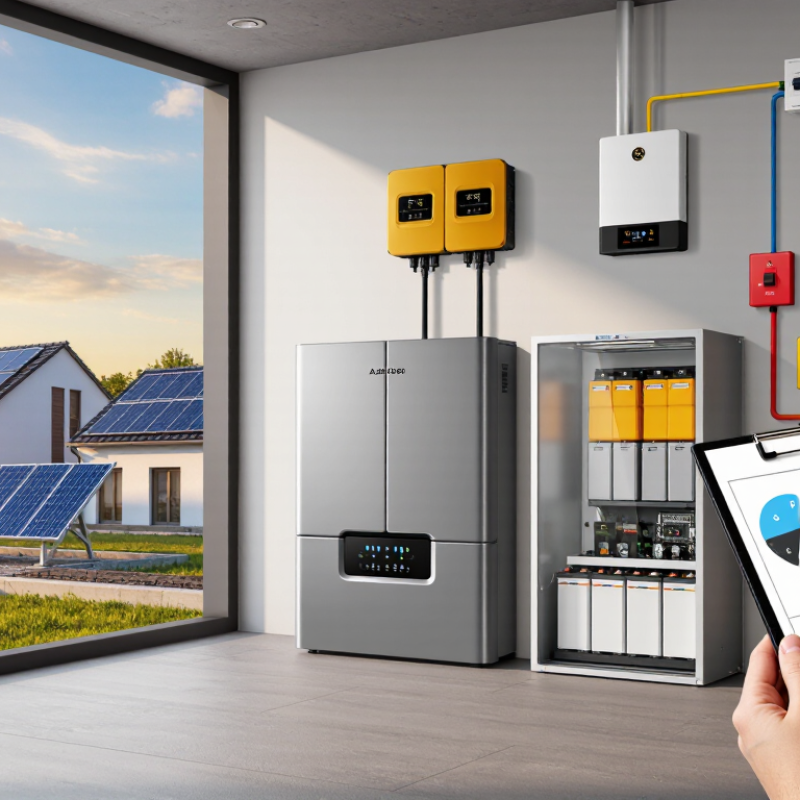
Choosing a home battery starts with observing how your household uses electricity, not with a headline capacity figure. Review several months of utility bills and note daily consumption, seasonal changes, and evening use. Then list the circuits you would want during an outage: perhaps the refrigerator, a few lights, internet equipment, and a medical device. Keep it practical. A whole-home backup may sound reassuring, but it can require much more storage than essential-load backup.
Check both energy capacity, measured in kilowatt-hours, and power output, measured in kilowatts. Capacity indicates how long stored energy may last; output affects how many appliances can run at once. A refrigerator cycling alongside lights is different from starting a well pump or running an electric oven. These details matter. Ask a qualified installer to review appliance labels and startup demands, and compare estimates with your real usage rather than an idealized scenario.
Think about how long you want backup power to last and whether solar panels can recharge the system during an outage. Cloudy weather can limit that recharge, so avoid assuming every day will be sunny. Consider future changes, too, such as an electric vehicle or a heat pump. Still, forecasting household needs is imperfect. A modest, well-matched system may serve you better than paying for capacity you rarely use.
Choosing a solar storage system in 2026 starts with matching the battery to your daily use, not chasing the largest number. Lithium iron phosphate batteries are often chosen for their long cycle life and thermal stability, while other lithium-ion chemistries may offer a compact footprint. Check the manufacturer’s usable capacity, warranty conditions, and operating temperature range. A battery rated at 10 kWh may provide less than 10 kWh for everyday use. That difference matters during a cloudy evening.
Capacity describes how much energy a battery stores; power describes how quickly it can deliver it. A 10 kWh battery with a 3 kW output may run lights, a refrigerator, and a router, but struggle with several large appliances running together. List the devices you expect to use during an outage, then check their starting and continuous power demands. One detail is easy to miss: pumps and compressors can briefly draw much more power when they start. Your estimates may still be imperfect, so leave some margin.
Tips: Compare usable capacity, continuous output, surge output, and round-trip efficiency on the same basis. Ask whether the system can expand later, and confirm that its inverter matches your solar array and household loads. If backup matters, test which circuits the system can actually support. Paper ratings can look reassuring; real use is less tidy.
How to Choose Solar Energy Storage Systems in 2026?
Check Solar Inverter Compatibility and Safety Standards
Before buying a battery, check the inverter’s voltage range, power rating, and approved battery communication protocol. A system may look compatible on paper yet fail to share charge limits correctly. Ask the installer to confirm compatibility in writing, including whether the inverter can manage backup loads during an outage. Check the equipment labels and installation manual, not just a product comparison chart. Small details matter.
The International Energy Agency reported that battery storage additions in the power sector reached about 42 gigawatts in 2023, a 130% increase from 2022. That rapid growth makes careful equipment selection more important, not less. For safety, look for relevant certifications such as UL 9540 for energy storage systems and UL 9540A testing for thermal runaway fire propagation. Inverter certification may include UL 1741 and IEEE 1547 requirements, depending on local rules and grid connection. Requirements vary by location, so have a qualified installer verify them.
Inspect the proposed wiring diagram. It should show battery disconnects, overcurrent protection, grounding, and the inverter’s location. Ask how the system behaves if communication is lost. I would not treat a passing certification as proof that every installation is safe; poor ventilation or incorrect wiring can still create problems. Check clearances, labels, and service access before signing off.
Check Solar Inverter Compatibility and Safety Standards
How to read this chart: Residential storage systems commonly use low-voltage batteries around 48 V or high-voltage batteries, often within approximately 200–500 V DC. Confirm that the inverter supports the battery’s voltage range, chemistry, communication protocol, and charge/discharge limits. Also check applicable certifications and installation requirements: UL 9540 evaluates energy storage systems, UL 9540A is a thermal-runaway fire-propagation test method, IEC 62619 covers safety requirements for industrial lithium batteries, and IEEE 1547 addresses distributed energy resource interconnection.
How to Choose Solar Energy Storage Systems in 2026?
Evaluate Costs, Incentives, Warranties, and Installation
Start with the loads you need during an outage, not the largest battery available. A refrigerator, a few lights, and a router use less energy than electric heating or a well pump. Check appliance labels and recent utility bills, then ask an installer to estimate usable capacity and peak power. These figures matter: a battery may store enough energy but still struggle to start a large motor. Get a written quote that separates equipment, labor, electrical upgrades, and permits. Costs vary by home, and estimates can be imperfect.
Compare incentives only after checking current eligibility, application deadlines, and whether the quoted price includes them. Programs can change, so verify details with official government or utility sources. Read warranty terms for coverage years, energy throughput, retained capacity, and service responsibilities. A long warranty sounds reassuring, but its conditions matter. Ask who handles a fault and how quickly support is available. Have the installer inspect your electrical panel, proposed battery location, ventilation needs, and backup circuits before signing. Request local references and proof of relevant credentials.
Tips
Ask for two or three itemized quotes. Confirm whether the system can operate during a grid outage; some setups need specific backup equipment. Clarify inspection, commissioning, and monitoring arrangements. Photograph the installation area beforehand. Keep the contract, warranty, and final test results together. One detail is easy to miss: battery performance depends on temperature and usage, not just the advertised capacity. I would leave room for that uncertainty when comparing savings claims.
A solar storage system should keep essential circuits running when the grid fails, not merely offer an impressive capacity figure. List what matters during an outage: the refrigerator, a few lights, internet equipment, or a medical device. Then check the system’s continuous output and surge capacity against those loads. A battery may store plenty of energy yet struggle to start a pump or compressor. That detail is easy to miss.
Plan for expansion, too. Your household may add an electric vehicle, a heat pump, or more solar panels later. Ask whether extra battery modules can be added, and whether the inverter can support the larger system. Check the usable capacity, not only the advertised total. Leave physical space for equipment and allow for safe ventilation and service access. A neat installation matters. So does the cable route.
Future use is less predictable than a sales estimate suggests. Review the warranty, expected capacity retention, monitoring tools, and availability of qualified service. Compare how the system behaves during cloudy days and long outages, not just under ideal conditions. I would avoid sizing around one perfect forecast; household habits change, and my own estimates can be wrong. Choose a system with clear limits, room to adapt, and support you can actually reach.
| System consideration | What to check | Why it matters | Practical selection guidance |
|---|---|---|---|
| Battery chemistry | Lithium iron phosphate (LFP), nickel manganese cobalt (NMC), lead-acid, or flow battery | Chemistry affects usable capacity, cycle life, efficiency, footprint, maintenance, and safety requirements. | LFP is widely used for stationary storage; compare the warranty and tested performance of the specific system. Lead-acid generally requires shallower discharge for longer service life. |
| Usable energy capacity | Usable kilowatt-hours (kWh), rather than nominal capacity alone; permitted depth of discharge | Usable capacity determines how much energy is available to power loads after sunset or during an outage. | Estimate essential-load energy over the intended backup period, then account for conversion losses and reserve capacity. Do not assume the full nameplate capacity is available. |
| Power output | Continuous and peak output in kilowatts (kW), surge duration, and supported voltage | A battery may have enough stored energy but still be unable to run several large loads at the same time. | Add the running loads that may operate together and check starting surges for motors, pumps, and compressors. |
| Round-trip efficiency | The proportion of charging energy returned as usable energy, measured for the complete system where possible | Energy is lost during charging, storage, and conversion. Published figures may use different test conditions or exclude some components. | Compare like-for-like AC or DC system figures and review the conditions, operating limits, and whether standby consumption is included. |
| Expansion capability | Approved battery-module additions, maximum supported capacity, inverter limits, and compatibility rules | Future expansion can be constrained by inverter power, battery-management controls, firmware, or permitted module combinations. | Ask for the maximum supported system size and the process for adding modules later. Confirm whether new and older modules can operate together. |
| AC-coupled or DC-coupled design | Connection to the home’s AC circuit or to the solar array’s DC side; inverter and retrofit requirements | The design affects retrofit compatibility, conversion paths, equipment requirements, and how solar generation is routed. | AC coupling is often considered for existing solar systems; DC coupling may suit some new installations. Have a qualified installer assess the actual layout. |
| Backup operation | Automatic transfer, backup circuits, whole-home support, and operation during a grid outage | Many grid-connected solar systems shut down during an outage unless configured with suitable backup equipment. | Verify which circuits stay powered, transfer behavior, backup power limits, and whether solar can recharge the battery while the grid is down. |
| Warranty and service life | Warranty term, energy-throughput limit, retained-capacity threshold, and operating-temperature conditions | A stated warranty period alone does not show how much energy the battery may deliver or how much capacity it must retain. | Read the full warranty, including exclusions, throughput limits, labor coverage, and requirements for installation and monitoring. |
| Safety and installation | Applicable local electrical and fire codes, listed equipment, clearances, ventilation, and installer qualifications | Battery installation requirements vary with equipment, site, and local rules; placement can affect safety and approval. | Use a qualified installer and confirm permitting, utility interconnection, emergency shutoff, and location requirements before purchase. |
| Monitoring and controls | State-of-charge monitoring, time-of-use scheduling, reserve settings, software support, and data access | Controls help align charging and discharge with household needs, utility tariffs, and backup reserves. | Check that settings are understandable, remote monitoring is supported, and the system can maintain a chosen backup reserve. |
| Future compatibility | Support for planned solar additions, an EV charger, heat pumps, generator integration, or changing utility tariffs | Future loads or equipment may require different power levels, controls, or electrical connections. | Ask the installer to document capacity and compatibility limits for likely future upgrades before finalizing the design. |
Values and capabilities vary by system, installation, operating conditions, and local requirements. Confirm specifications using current product documentation and a qualified installer.