How to Choose the Right Forklift Actuator?
Choosing the right Forklift Actuator begins with understanding the machine’s real working conditions. A compact warehouse forklift may need smooth, quiet movement, while a heavy-duty truck faces dust, vibration, cold storage, and repeated load cycles. The actuator must match the required force, stroke length, operating speed, mounting space, and control system. A small mismatch can cause slow lifting, unstable tilting, excess heat, or premature component failure.
“An actuator should be selected for the work cycle, not merely for its maximum force,” explains Daniel Mercer, a senior materials-handling systems engineer. His point is practical. Maximum capacity alone does not reveal how the unit performs during hundreds of daily movements. Buyers should examine peak load, average load, duty cycle, response accuracy, sealing quality, and emergency stopping behavior. Hydraulic, electric, and electromechanical designs each offer different advantages. Hydraulic models often deliver strong lifting power. Electric actuators can provide cleaner and more precise control.
Measure twice.
Real installation details also matter. Check the available mounting angle, connector position, cable protection, and maintenance access before ordering. Consider moisture, battery voltage, ambient temperature, and compatibility with the forklift’s controller. A neat specification sheet may still miss a harsh loading dock or an uneven floor. That assumption can fail. Field trials, supplier documentation, and feedback from trained technicians can expose weaknesses early. The best Forklift Actuator is not always the strongest option. It is the one that delivers dependable movement, safe control, and reasonable service life within the forklift’s actual operating environment.
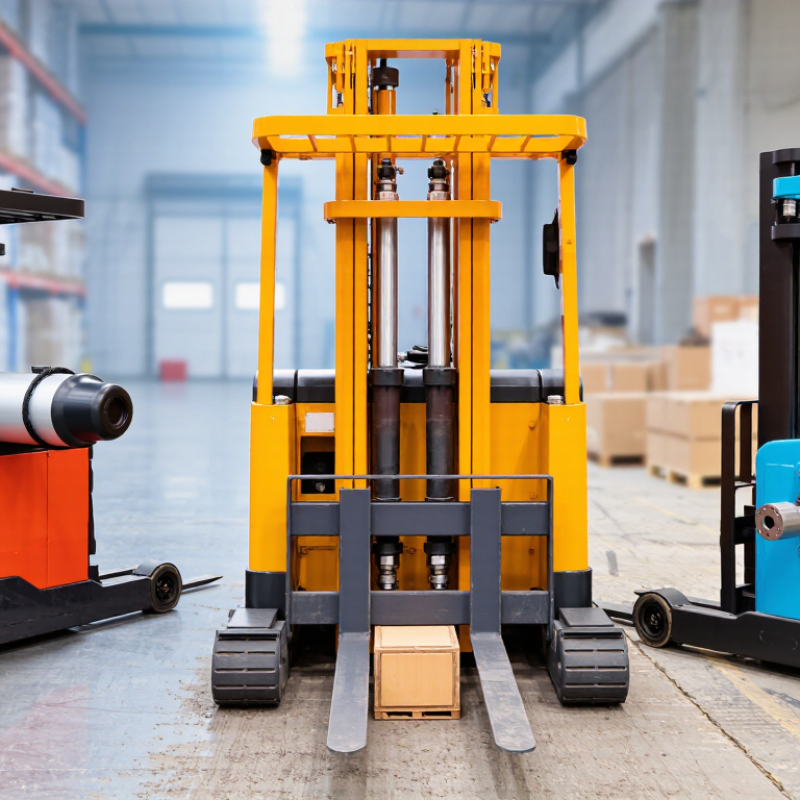
Define Forklift Actuator Types: Hydraulic, Electric, and Linear Systems
How to Choose the Right Forklift Actuator?
Forklift actuators convert stored energy into controlled movement. In practical warehouse work, the right choice depends on load weight, travel speed, duty cycle, and maintenance access.
Hydraulic actuators deliver strong lifting force and tolerate demanding loads. They suit frequent lifting, uneven surfaces, and heavy attachments. However, hoses can leak, and fluid temperature may affect performance. This detail is easy to overlook.
Electric actuators use motors, gears, or screw mechanisms. They provide clean, precise movement with lower routine maintenance. They work well in indoor facilities where noise and emissions matter.
Battery capacity becomes critical during long shifts. A weak battery can reduce speed before the operator notices. Electric systems also need protection from dust, moisture, and impact.
Tips: Match the actuator’s rated force with the real working load, not the average load.
Check stroke length, response speed, mounting space, and duty cycle.
Linear systems are valuable when accurate extension or positioning matters, such as side-shifting or controlled attachment movement.
Ask technicians to inspect seals, connectors, and mounting pins during scheduled service.
Field measurements are useful. Catalog figures alone may mislead.
If the forklift works across different zones, test the actuator under cold, warm, and peak-load conditions before final selection.
Match Actuator Force to Load Capacity, Lift Height, and Duty Cycle
How to Choose the Right Forklift Actuator?
Actuator force must match the real load, not only the nameplate rating. Measure the load center, pallet weight, attachment weight, and any uneven distribution. A 2,000-kilogram load may create greater cylinder demand when its center shifts forward. Calculate static force, friction, and acceleration separately. Then apply a documented safety margin, commonly 1.25 to 1.5, after engineering review. Do not guess.
Lift height also changes the actuator’s working conditions. Higher lifting increases mast leverage, bending stress, and hydraulic pressure demand. Check the actuator force at the most difficult position, not only at floor level. ISO 3691-1:2023 addresses safety requirements for industrial trucks, while OSHA’s Powered Industrial Trucks eTool reports about 85 annual fatalities and 34,900 serious injuries in the United States. These figures show why stable sizing matters.
Duty cycle decides whether the actuator survives daily work. Record lifts per hour, stroke length, idle time, temperature, and peak pressure. A warehouse truck making 20 gentle lifts per shift needs different thermal performance from a truck lifting continuously. Review seal wear, motor heating, oil viscosity, and emergency-stop behavior. Short duty cycles can still create sharp loads. I have seen “correct” force ratings fail because cycle data was missing. Recheck the calculation with measured pressure and actual lift speed. The first estimate may be wrong.
The recommended actuator force is calculated from the rated load using Force = Load × 9.81 m/s² × 1.25 design factor, assuming a direct vertical lift. Higher lift heights and more frequent duty cycles may require additional allowance for friction, structural deflection, thermal capacity, and repeated-load fatigue. Final actuator selection should be verified against the forklift linkage and operating conditions.
Verify 24 V, 36 V, 48 V, and 80 V Electrical Compatibility
Choosing the right forklift actuator starts with electrical compatibility, not housing size. Voltage matters. A 24 V actuator belongs on a 24 V truck system, while 36 V, 48 V, and 80 V systems require matching electronics. A higher-voltage unit may overheat instantly. A lower-voltage unit may stall, move slowly, or trigger repeated faults.
Check the battery’s nominal and charging voltage with a multimeter. An “80 V” battery can produce a higher charging voltage, so the actuator’s operating range must cover that peak. Review polarity, connector pinout, fuse rating, current draw, and inrush current. EN 1175:2020 and ISO 3691-1 provide useful electrical and safety references for industrial trucks. Their requirements remind engineers that wiring protection and control reliability matter as much as motor output. A practical test should include lifting, lowering, cold starts, and repeated cycles.
MHI’s 2024 Annual Industry Report found that 83% of surveyed professionals expect significant or very significant supply-chain change. Electrification remains part of that shift, but rushed substitutions create avoidable failures. I would not trust a voltage label alone. Confirm the controller signal, duty cycle, ambient temperature, and actuator load. Some specifications remain unclear, especially with refurbished equipment. That deserves a second inspection. Measure twice. Then document the result before installation.
How to Choose the Right Forklift Actuator? - Verify 24 V, 36 V, 48 V, and 80 V Electrical Compatibility
Electrical compatibility reference for selecting a forklift actuator. Always confirm the actuator nameplate, controller specifications, battery chemistry, wiring, and protection requirements before installation. | Forklift System Voltage | Typical Lead-Acid Battery Configuration | Indicative Battery Voltage Envelope* | Actuator Voltage Requirement | Controller and Wiring Check | Compatibility Decision |
| 24 V | 12 lead-acid cells, commonly two 12 V battery blocks in series | Approximately 21.0–28.8 V DC | Use a 24 V actuator or a controller explicitly rated for the complete operating range | Verify input undervoltage and overvoltage limits, polarity, cable cross-section, connector rating, and fuse protection | Suitable only when the actuator and controller accept the measured 24 V system range |
| 36 V | 18 lead-acid cells, typically three 12 V battery blocks in series | Approximately 31.5–43.2 V DC | Use a 36 V actuator or a controller specifically designed for 36 V traction systems | Check the actuator’s continuous and peak current against the controller, conductors, fuse, and contactor ratings | Suitable when both nominal voltage and full battery voltage range are supported |
| 48 V | 24 lead-acid cells, commonly four 12 V battery blocks in series | Approximately 42.0–57.6 V DC | Use a 48 V actuator or an isolated DC-DC supply rated for the forklift’s electrical environment | Confirm switching device voltage rating, transient protection, grounding method, and maximum actuator inrush current | Suitable only if the actuator is rated above the highest measured charging voltage |
| 80 V | 40 lead-acid cells, commonly an 80 V industrial traction battery | Approximately 70.0–96.0 V DC | Use an 80 V actuator, an appropriately rated controller, or a properly specified isolated power converter | Verify creepage, clearance, insulation, connector spacing, touch protection, fuse interrupt rating, and enclosure requirements | Suitable only after high-voltage insulation and protection requirements are confirmed |
*Important voltage note: The voltage envelopes above are indicative values for lead-acid traction batteries, using approximately 1.75 V per cell as a low-voltage reference and 2.40 V per cell as a charging reference. Lithium battery packs and other battery chemistries can have different voltage limits. Do not select an actuator from nominal voltage alone.
Final selection checklist: Confirm nominal voltage, minimum and maximum input voltage, continuous and peak current, duty cycle, stroke, load capacity, mounting dimensions, environmental protection, control signal type, emergency-stop behavior, and compatibility with the forklift’s battery management and control system.