7 Tips for Choosing a China Flat Washer Supplier
Choosing a China Flat Washer supplier is not just a price comparison. It is a decision about dimensions, material consistency, surface finish, and repeatable production. The World Steel Association reported that China produced 1,019.1 million tonnes of crude steel in 2023, about 54% of global output. That scale signals a substantial industrial base, but it does not guarantee that any individual washer meets your requirements. Check the supplier’s actual process.
Quality expert Joseph M. Juran’s principle, “Quality does not happen by accident; it must be planned,” is relevant to sourcing hardware. Ask how the supplier controls thickness, outside diameter, burrs, and coating. Request material certificates, inspection records, and samples from a production run—not only a hand-picked piece. Look closely at the washer edge under good light. A sharp burr can damage a mating surface; uneven zinc coating may signal inconsistent finishing. Small details matter.
Even a polished sample can hide a weak process. That is easy to miss. The seven tips below focus on practical checks: technical capability, quality systems, material traceability, customization, communication, lead times, and total cost. Compare evidence, not promises. A supplier’s answer should be specific enough to verify, yet clear enough for your engineers and purchasing team to use. Some buyers still prioritize the lowest quote. That can work for simple orders, but only when specifications and inspection expectations are clear.
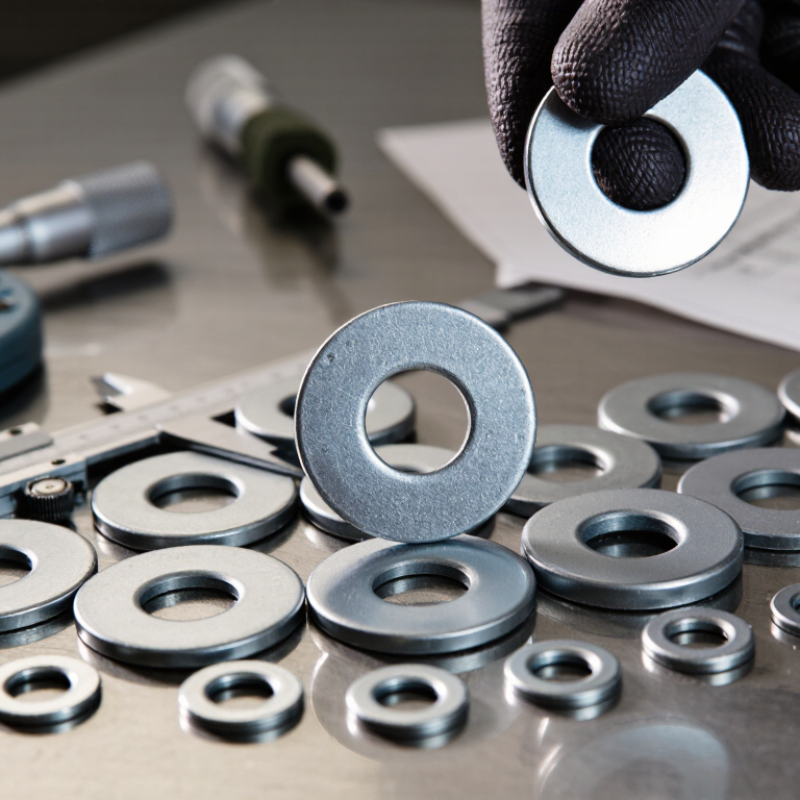
Define Your Flat Washer Specifications and Application Requirements
Before comparing China flat washer suppliers, write down the washer’s dimensions and intended job. Specify the inner diameter, outer diameter, thickness, and acceptable tolerances. A washer that looks close may still bind on a bolt or cover too little of the joint. Measure the actual mating parts when possible. Small details matter.
Describe the assembly, not just the part. Note the bolt size, clamped materials, expected load, and whether vibration is present. State the operating environment, including moisture, chemicals, or temperature changes. These details help a supplier recommend a suitable material and surface finish. For example, a washer used outdoors may need different corrosion protection from one inside a dry machine housing. Keep relevant drawings and sample parts available. This step is easy to rush.
Ask how the supplier will verify the requirements. Request dimensional inspection records and material documentation where appropriate, and confirm which standard or drawing revision applies. Clarify packaging and traceability if washers will be used across multiple production batches. Be specific, but realistic: not every application needs unusually tight tolerances. I have seen specifications become more complicated than the assembly itself. Review the details with your design or quality team, then share one clear, current specification with each supplier.
Check the Supplier’s Manufacturing Capacity and Product Range
A supplier’s stated capacity matters only when it matches your washer specifications. Ask what equipment is used for stamping, forming, and finishing, and whether these processes happen in-house. A small flat washer and a thick, large-diameter washer may require different tooling and production time. Ask for typical monthly output for the sizes you need, not just the factory’s total capacity. Request recent sample measurements and inspection records. Check thickness, inner diameter, outer diameter, and burr condition. Ask for specifics.
Product range is just as important. Confirm available materials, thicknesses, diameters, and surface finishes, then ask which options are stocked and which require a production run. A broad catalog can look impressive while some sizes are only sourced elsewhere. That distinction affects lead time and consistency. If you need several washer sizes, ask whether the supplier can provide them under one order and keep specifications clear across batches. Review sample parts against your drawing, and clarify how changes are documented. No single check proves long-term reliability, and a polished sample may not represent every production lot. Still, comparing the sample, records, and stated capacity gives you a more useful picture.
Verify Materials, Industry Standards, and Quality Controls
A reliable China flat washer supplier should explain exactly what each washer is made from. Ask for the material grade, a mill test report, and batch traceability. The paperwork should match the shipment, not just a sample from last year. Check whether the washer’s material and finish suit the load, temperature, and environment. Small details matter.
Standards need careful checking. A supplier may quote ISO, DIN, or another specification, but confirm the exact standard and revision against your drawing. Compare dimensions such as inner diameter, outer diameter, thickness, and permitted tolerances. Ask how surface treatments affect dimensions or corrosion resistance. “Meets the standard” is not enough on its own. Get the relevant inspection records.
Quality controls should be visible in practice. Ask how incoming material is checked, how measuring tools are calibrated, and how production lots are sampled. A sample washer can reveal burrs, uneven edges, or a rough finish under close inspection. Request a dimensional report for the actual order. No checklist catches everything; I would still examine a delivered batch before approving repeat production. A little doubt is useful.
Compare Pricing, Minimum Orders, and Delivery Options
A low price per China flat washer can be misleading if freight, inspection, or packaging costs are missing. Compare like with like: specify the washer’s inner and outer diameters, thickness, material, finish, and required quantity. Ask suppliers to quote the same specifications and show tooling or setup charges separately. Small orders cost more. Check whether the quoted price applies to a sample run, a trial order, or repeat production.
Minimum order quantities affect cash flow and storage, not just unit cost. Compare the supplier’s MOQ with your actual usage, then request price breaks at realistic quantities, such as 1,000, 5,000, and 10,000 pieces. Ask whether mixed sizes can count toward one order; some suppliers may allow this, while others cannot. A large discount is less useful if cartons sit unused for months. Forecasts are imperfect, so leave room for demand changes.
Delivery options deserve the same scrutiny as price. Request production time, packing details, dispatch point, and estimated transit time for each shipping method. A cheaper route may take longer, while faster freight can raise the landed cost sharply. Confirm how tracking and delays are handled, and ask whether partial shipments are possible. Do not rely on a single estimated date. Build a buffer, especially when washers are needed for a scheduled assembly run.
Assess Communication, Customization, and After-Sales Support
A China flat washer supplier should answer practical questions clearly, not only send a price list. Ask how quickly they respond and who handles technical questions. A useful reply confirms dimensions, material, thickness, and finish in writing. Details matter. If your drawing shows a 12 mm inner diameter, ask the supplier to repeat that measurement and its tolerance. Vague replies can signal a communication gap before production begins.
Customization needs careful discussion. Share a drawing or sample, then ask which features can be adjusted and what limits apply. Confirm outer diameter, edge condition, material grade, surface treatment, and packaging before approving a sample. Request measurements from the sample, not just a photo. This takes time. Still, a custom part may need more than one revision; it is easy to assume a drawing explains everything, and that assumption can be wrong.
After-sales support matters when a shipment has mixed dimensions or visible defects. Ask how the supplier records production batches, reviews a complaint, and proposes corrective action. A dependable process should include a response timeline and clear evidence, such as inspection records or replacement terms. Test this support with a specific question before placing a large order. Fast replies are useful, but follow-through is what counts. I would not judge a supplier by one delayed email alone; context matters, though repeated silence deserves attention.