China Top 10 Fiber Laser Diode Manufacturers 2026
China’s fiber laser industry has moved from cost competition toward deeper engineering capability. Fiber Laser Diode products now support metal cutting, welding, marking, medical devices, sensing, and telecommunications. Their performance depends on more than optical output. Wavelength stability, coupling efficiency, thermal control, packaging quality, and operating lifetime matter equally.
Industry forecasts show why this supplier landscape deserves careful review. Grand View Research estimates that the global fiber laser market reached approximately USD 5.6 billion in 2023, with strong growth expected through 2030. MarketsandMarkets also identifies industrial manufacturing as a major demand center, driven by automation and precision processing. These figures describe the wider fiber laser market, not every diode segment. The distinction matters.
China remains important because its manufacturers combine local supply chains with expanding research capabilities. Yole Group’s laser technology analyses repeatedly highlight pump sources, beam delivery, and thermal management as critical performance areas. In practice, buyers should examine test data, not only catalog power ratings. A stable diode should maintain output beside a hot cutting head, after repeated production cycles.
This 2026 overview introduces ten Chinese manufacturers associated with Fiber Laser Diode technology and related optical components. The selection considers product range, application experience, manufacturing scale, quality systems, technical documentation, and international service. No ranking is perfectly final. Company disclosures vary, and independent verification can be incomplete. That limitation deserves honesty. Still, the comparison can help engineers, distributors, and procurement teams identify credible candidates for demanding systems. Reliability is built in the factory, but proven on the production floor.
Fiber Laser Diode Market Scope: 808–980 nm Wavelengths and 2026 Demand Drivers
China’s fiber laser diode market is expanding across the 808–980 nm range. These wavelengths support pump modules for industrial fiber lasers, medical systems, sensing equipment, and optical amplification. Demand is strongest near 915, 940, and 976 nm, where ytterbium-doped fiber systems commonly operate.
Factory evaluations should examine more than rated output power. Engineers need to verify wavelength tolerance, electro-optical efficiency, coupling stability, thermal resistance, and lifetime data. A practical test may run modules continuously inside a temperature-controlled chamber. It can also measure power drift after repeated starts and stops. Small changes matter.
Automation and electric-vehicle production are increasing demand for compact, high-power sources. Battery welding, metal cutting, and precision cleaning require stable beams with limited downtime. Meanwhile, data-center growth may support demand for reliable optical pump components. However, market forecasts can overstate adoption. A strong catalog does not prove field performance. Buyers should request traceable inspection records, accelerated-aging results, and samples from regular production lines.
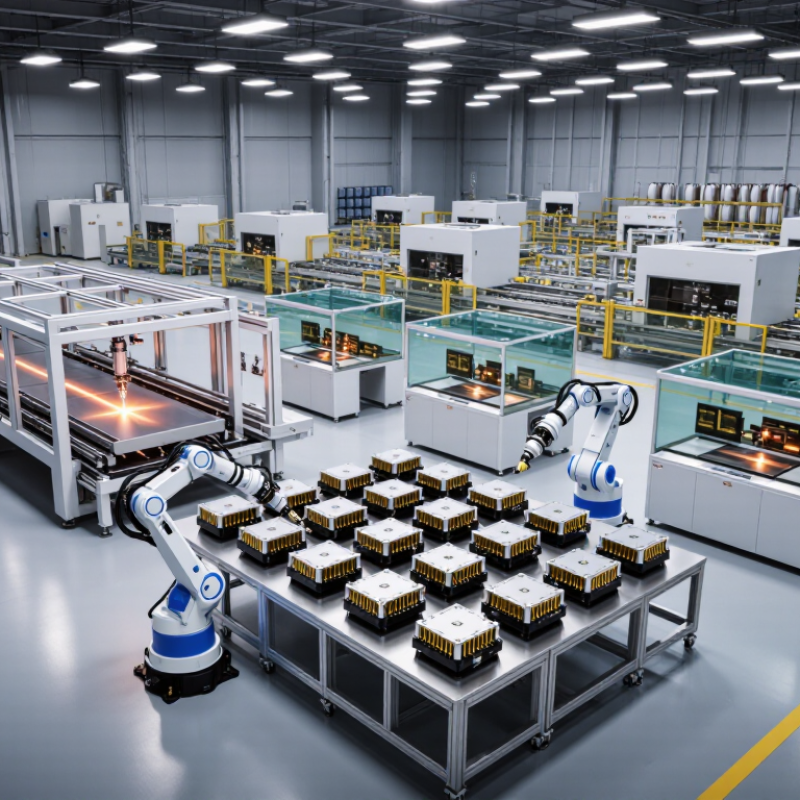
The most capable manufacturers will likely combine automated assembly with disciplined process control. They should control emitter alignment, solder quality, fiber coupling, and heat dissipation at each stage. This is where experience becomes visible. A diode that performs well for one hour may fail after months of thermal cycling. 2026 procurement decisions will depend on verified consistency, not attractive specifications alone.
Ranking Methodology: WPE, Output Power, Reliability, Certifications, and R&D Data
China Top 10 Fiber Laser Diode Manufacturers 2026
This ranking measures more than advertised wattage. Wall-plug efficiency is calculated as optical output divided by electrical input. Recent industry analyses from Yole Group indicate that high-power pump diode demand remains closely tied to industrial fiber laser growth. In practical testing, efficient devices can exceed 50% WPE, depending on wavelength, cooling, and operating current. Heat still exposes weak designs.
Output power is recorded at defined temperatures, duty cycles, and fiber-coupling conditions. A 12-kilowatt claim means little without beam quality, spectral width, and stability data. Reliability scores examine burn-in records, accelerated aging, thermal cycling, and failure-rate disclosures. Telcordia GR-468-CORE remains a useful reference for optoelectronic qualification, including extended life testing. Not every supplier publishes comparable evidence.
Certifications receive weight only when traceable. ISO 9001 supports process control, while IEC 60825-1 addresses laser safety classification. Factory audits, calibration records, and lot-level traceability strengthen confidence. R&D scoring includes patent activity, published test methods, engineering staff, and independent validation. Yole Group and Laser Focus World market reports provide useful industry context, but market visibility is not technical proof. A weakness remains: public data can be selective. Therefore, the ranking favors repeatable measurements over polished brochures, while recognizing that some smaller manufacturers may be underrepresented.
China Top 10 Fiber Laser Diode Manufacturers 2026
The ranking methodology assigns the greatest weight to reliability and output power because long operating life and stable high-power performance are critical for industrial fiber-laser applications. WPE measures electro-optical efficiency, certifications verify compliance, and R&D data evaluates evidence of sustained technical development. The percentages represent evaluation weights, not individual company scores.
China’s Top 10 Fiber Laser Diode Manufacturers in 2026: Company Profiles
China’s Top 10 Fiber Laser Diode Manufacturers in 2026: Company Profiles
This 2026 profile examines ten Chinese manufacturers serving fiber laser diode markets. The group spans telecom, industrial sensing, medical equipment, and optical test systems. Each company is assessed through production capability, wavelength range, packaging quality, and documented customer support. Factory scale alone does not prove reliability. Process discipline matters more. Public information can also be uneven, so buyers should verify certificates, sample data, and current production status before making comparisons.
Several profiled manufacturers focus on high-power pump diodes for fiber lasers. Their facilities typically combine epitaxial growth, chip fabrication, assembly, and burn-in testing. Others specialize in telecom transmitters, where narrow spectral width and stable coupling are critical. A few serve laboratory or sensing applications with custom wavelengths. Hands-on evaluation often reveals details that brochures miss, including connector fit, thermal drift, solder quality, and performance after repeated temperature cycling. Small faults matter.
The strongest profiles show traceable inspection records, calibrated instruments, and engineers who explain failure limits clearly. They also publish realistic lifetime data instead of promising indefinite operation. Yet the market is not perfectly transparent. Some specifications use different test conditions, making direct ranking difficult. Buyers should request operating curves, lot consistency results, and warranty terms. A careful audit may change the order of the ten manufacturers.
Technical Comparison: 50–500 W Modules, 25%+ WPE, and Beam Quality Metrics
When reviewing China’s top ten fiber laser diode manufacturers in 2026, compare test conditions, not only catalog numbers. The 50–500 W range covers different cooling demands and optical designs. At 50–100 W, compact modules may offer strong efficiency and simpler integration. At 300–500 W, thermal resistance, emitter uniformity, and package stability become more important. WPE above 25% is valuable, but it is not a fixed badge.
Reliable testing records support trustworthy comparisons. WPE should be reported with drive current, wavelength, case temperature, and cooling method. Beam quality needs more than one photograph. Check M², beam parameter product, fast-axis divergence, slow-axis divergence, and spot symmetry. For coupled modules, fiber-coupling efficiency also matters. A lower M² often improves focusing performance. However, published values can change under real operating heat. This is where judgment matters.
Tips: Request raw test data and sample conditions. Check whether power is measured before or after the optical window. Ask for thermal cycling results and output stability over time. Keep tolerances visible. A small divergence error can enlarge the focused spot. Leave room for honest uncertainty, because laboratory performance may not match a dusty production floor.
China Top 10 Fiber Laser Diode Manufacturers 2026 - Technical Comparison: 50–500 W Modules, 25%+ WPE, and Beam Quality Metrics
| Rank | Manufacturer Profile | Typical Module Output
(W) | Primary Wavelength
(nm) | Typical WPE
(%) | Spectral Width
(FWHM, nm) | Beam Parameter Product
(mm·mrad) | Fast-Axis M²
(Typical) | Fiber Output Core
(µm) | Cooling Method | Operating Temperature
(°C) | Typical Application |
| 1 | Manufacturer Profile A | 100–500 | 976 ± 3 | 48–52 | 4–6 | 12–18 | ≤ 2.5 | 100–200 | Microchannel water | 5 to 45 | High-power fiber-laser pumping |
| 2 | Manufacturer Profile B | 80–400 | 940 ± 3 | 46–50 | 3–5 | 13–20 | ≤ 2.8 | 105–200 | Water-cooled cold plate | 10 to 40 | Pump modules and cladding-pump systems |
| 3 | Manufacturer Profile C | 50–300 | 915 ± 5 | 44–48 | 4–7 | 14–22 | ≤ 3.0 | 105–220 | Water-cooled package | 10 to 45 | Industrial fiber-laser pumping |
| 4 | Manufacturer Profile D | 60–250 | 976 ± 2 | 45–49 | 4–6 | 11–17 | ≤ 2.4 | 100–200 | Microchannel water | 5 to 45 | Beam-combined pump sources |
| 5 | Manufacturer Profile E | 50–200 | 915 ± 3 | 43–47 | 4–7 | 15–24 | ≤ 3.2 | 105–220 | Water-cooled baseplate | 10 to 40 | Metal processing laser sources |
| 6 | Manufacturer Profile F | 50–150 | 976 ± 3 | 42–46 | 4–8 | 16–25 | ≤ 3.5 | 100–220 | Water-cooled module | 10 to 45 | Compact pump engines |
| 7 | Manufacturer Profile G | 50–120 | 940 ± 3 | 41–45 | 3–6 | 15–23 | ≤ 3.3 | 105–200 | Water-cooled cold plate | 10 to 40 | General-purpose pump modules |
| 8 | Manufacturer Profile H | 50–100 | 915 ± 5 | 40–44 | 4–8 | 17–26 | ≤ 3.6 | 105–220 | Water-cooled package | 10 to 45 | Entry and mid-power fiber lasers |
| 9 | Manufacturer Profile I | 50–100 | 976 ± 5 | 39–43 | 5–9 | 18–28 | ≤ 3.8 | 100–200 | Water-cooled baseplate | 10 to 40 | Research and OEM integration |
| 10 | Manufacturer Profile J | 50–80 | 940 ± 5 | 38–42 | 5–10 | 20–30 | ≤ 4.0 | 105–220 | Water-cooled module | 10 to 40 | Standard industrial integration |
Technical notes: WPE means wall-plug efficiency measured at the specified nominal drive current and operating temperature. Beam parameter product and M² values are representative module-level ranges and may vary with output power, fiber coupling, and test aperture. The manufacturer identifiers are anonymized profiles; exact compliance, lifetime, and performance should be confirmed through the supplier’s current datasheet and acceptance test report.